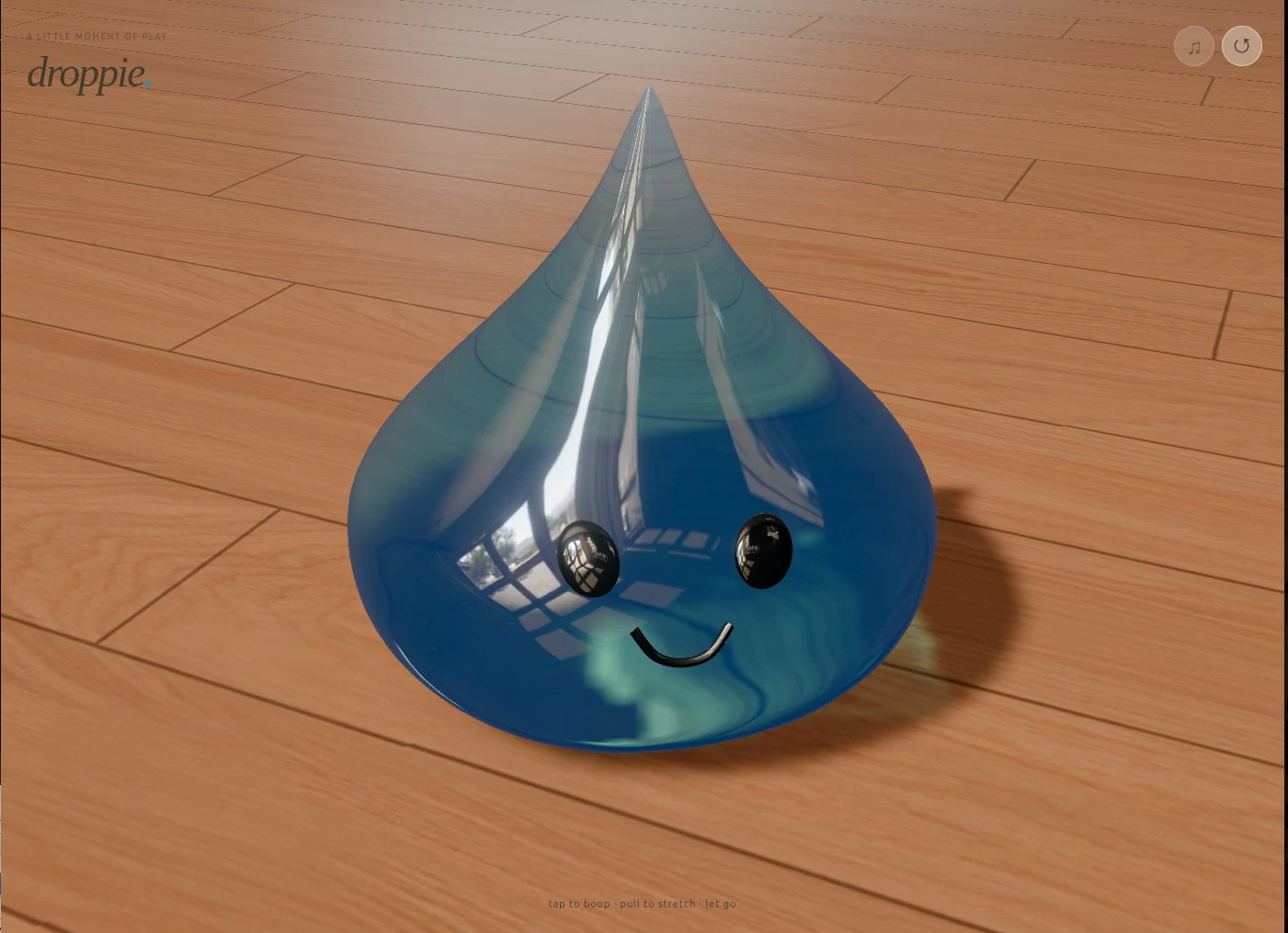
Droppie: my turn to show off Astra
A tiny living water droplet built with GPT-6 Astra — soft-body physics, WebGPU refraction, and procedural audio.
My turn to show off Astra. Droppie is a tiny living water droplet — tap, stretch, throw, and watch him wobble. It runs on mobile and desktop at boxwrench.github.io/Droppie.
Finding
The build ran on GPT-6 Astra under the Plus plan. The bulk of the work completed inside one 5-hour window; roughly half of the next window went to tweaking that was probably unnecessary. The inspiration is credited directly: @scottstts.
The artifact is a small laboratory, not just a toy. A tetrahedral XPBD soft-body cage advances at a fixed 240 Hz step, with the visible surface deformed from the cage rather than simulated directly. Rendering is WebGPU with transmission and refraction for the droplet look, plus an HDR room environment. Pointer interaction covers tap to hop, drag to stretch and throw, orbit on empty floor, pinch or scroll to zoom, Space to hop, R to reset, Escape to release. Sound is procedural Web Audio that unlocks after first interaction, with mute and reset buttons top-right. The details and full tutorial live in the readme.
Two constraints ship with it. The demo needs a WebGPU-capable recent browser in a secure context. First visit downloads roughly 12 MB of textures and environment; later visits use the browser cache.
Meaning
Two things matter here beyond the toy. First, the cost shape: one window of real building, half a window of optional polish. That ratio is the honest signature of a run where the model carried the implementation and the human spent the remainder on judgment calls about feel. The tweaking probably was not needed, which is itself information about where the model stopped and taste took over.
Second, the systems fit in one head. Soft-body cage, deformed surface, optical thickness, WebGPU pass, pointer gestures, procedural audio — each is small enough to read end to end, and the readme teaches them as connected pieces rather than black boxes. Some parts are physical approximations, others are deliberate cheats for sensation at low cost. That distinction, stated plainly in the docs, is what makes the project a laboratory instead of a demo.
Connection
This sits next to the kitten-rescue manager loop from the day before: a complete small game from one prompt and one image in 24 minutes on Muse Spark. Different model, different orchestration — direct building with Astra versus a phased manager loop — same outcome pattern. The structure that turns model output into a finished, playable artifact keeps mattering more than which model produced the tokens. And where the kitten post demonstrated endurance through phases, this one demonstrates density: a real-time physics core, a WebGPU renderer, and a sound system inside a single Plus-plan afternoon.
Play: boxwrench.github.io/Droppie. Source and tutorial: github.com/boxwrench/Droppie. Original post: x.com.