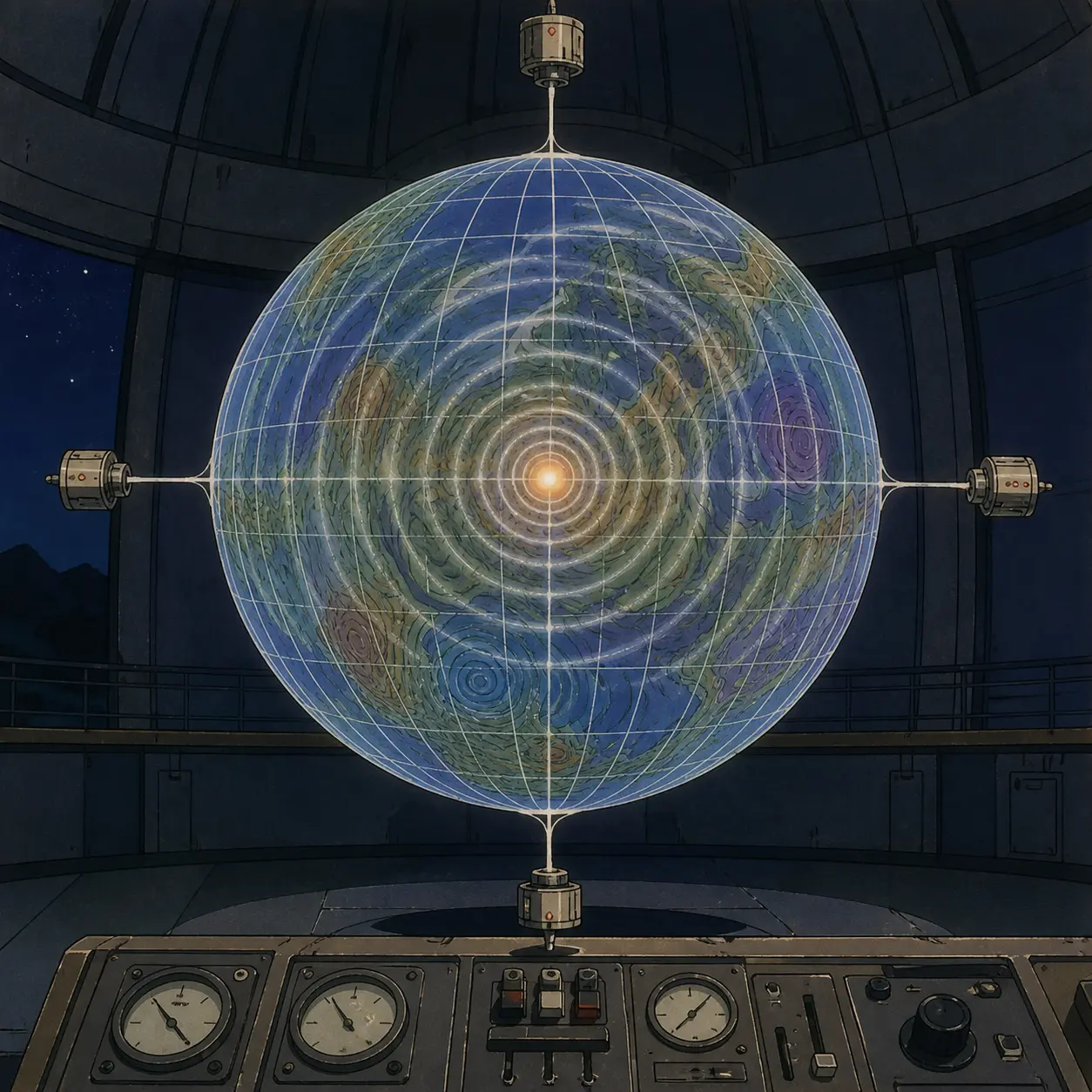
WeatherNext 2: Forecasting as Ensemble Perturbation
Google DeepMind open sourced its most accurate weather model. The mechanism is simpler than it looks.
Google DeepMind released the code and weights for WeatherNext 2 under Apache 2.0 at google-deepmind/weathernext. The repository includes the operational 0.25 degree global model that ran live during the 2025 Atlantic hurricane season, a 1 degree Mini variant that fits on a single P100, and the direct cyclone tracker used to derive tracks from gridded outputs. Live forecast feeds remain available through Google Cloud, WeatherLab, and Open-Meteo.
The release consolidates two papers: the Functional Generative Network technical report (arXiv:2506.10772, June 2025) describing the core method, and the operational tropical cyclone study published in Nature.
Finding
WeatherNext 2 is a 15-day global ensemble forecaster. Each state is 6 atmospheric variables at 13 pressure levels plus 6 surface variables on a 0.25 degree latitude-longitude grid, stepped every 6 hours from two prior frames. Training combines ERA5 reanalysis with fine-tuning on ECMWF HRES initial conditions so the model can be initialized directly from operational analyses rather than reanalysis.
The method is called FGN, for Functional Generative Networks. It does not use diffusion, flow matching, or adversarial objectives. Diversity is introduced at two levels. Aleatoric uncertainty — the irreducible spread of possible weather trajectories — comes from a low-dimensional noise vector injected as conditional normalization at each autoregressive step. This is equivalent to sampling a perturbation of the network weights. Epistemic uncertainty — uncertainty about the model itself — comes from ensembling four independently trained networks, each generating a subset of members.
Training minimizes Continuous Ranked Probability Score on per-location marginals. There is no explicit joint likelihood objective.
On reported metrics, FGN outperforms both ECMWF ENS and GenCast across deterministic and probabilistic scores, with similar-to-better calibration, comparable or better skill on extremes, and statistically significant improvement on cyclone track mean and track probabilities (p less than 0.05). The joint spatial structure — correlations between nearby locations — is reasonable despite never being trained for, which the authors attribute to the architecture preserving functional coherence through shared perturbations. A Mini 1 degree checkpoint reproduces the behavior at lower skill for local testing. Evaluation for earlier checkpoints trained through 2022 and 2023 is provided to allow reproduction of the paper figures.
The implementation is JAX, optimized for TPU. The reference Colab runs WN2 on a free v5e-1; larger checkpoints expect v5p or H100-class VRAM. Weights are hosted on the longstanding dm_graphcast Cloud Storage bucket.
Meaning
The interesting part is what was removed.
GenCast demonstrated that machine learning could beat the best physics ensemble, but it paid for ensemble spread with diffusion sampling. Diffusion brings quality at the cost of iterative denoising steps and a framework that is difficult to move beyond dense grids. FGN replaces that with a single forward pass perturbed by a small noise vector, plus a four-model ensemble. The result is faster at inference, simpler to train, and more flexible about output representation — mesh or sparse observations are not excluded by design.
Training on marginals alone should not in principle guarantee coherent fields. A model that predicts each location independently could match CRPS while producing spatially incoherent noise. That this does not happen here suggests the perturbation is acting as a low-rank functional prior: because the same conditioning perturbs the whole field through shared normalization, the variations it induces are spatially correlated by construction. The model was not taught what a physically consistent pattern looks like beyond what appears in the training targets; it inherited a bias toward coherent patterns from the way its weights are varied.
On cyclone skill, the operational consequence is straightforward. Track error governs preparation time and geography of warning. A statistically significant reduction in track error at medium range, if it persists outside the evaluation window and across basins, shifts where and when evacuation and staging decisions remain useful. The 2025 live season and the September 2025 tracker improvement described in the appendix are the relevant test of whether the benchmark gain transferred to operations.
What remains open is the familiar question for autoregressive weather models: drift and calibration at longer lead times, performance on rare extremes that remain sparse even in ERA5, and sensitivity to degraded or partial initialization. The authors provide checkpoint ablations and comparisons with ENS in the appendix to make the evaluation auditable, which matters more than the headline scores.
Connection
Weather forecasting and language modeling share a structural tension that has appeared repeatedly over the last three years. A deterministic point prediction is cheaper, clearer, and easier to optimize, but it overstates certainty. An ensemble is more honest about what follows from what is known, and more expensive to produce well.
A similar shift occurred when diffusion appeared in image generation: explicit likelihood gave way to iterative refinement that was powerful but slow. FGN moves in the opposite direction, from iterative generation back to a perturbed single pass. The analogy in engineering is the move from a complex process loop to a parametric perturbation of a simpler process. When the perturbation is designed to act globally, local coherence follows without being explicitly rewarded.
Earlier systems for sparse inference, adaptive computation, and mixture-of-experts reached the same conclusion by a different route: the cheapest way to obtain diverse but plausible outputs is often to vary how a single model executes, rather than maintaining entirely separate models for each possibility. Here the resource is ensemble spread; in language models it was inference cost; in both cases the mechanism is variation of a shared computation rather than duplication of it.
Weather remains a grounding test for probabilistic AI. Outcomes are observable, frequent, and measured on a fixed grid. A method that can generate plausible divergent futures for the atmosphere while being trained only on what happened at each location separately provides evidence that joint structure can emerge from how variation is introduced, not only from how it is penalized. That observation transfers beyond meteorology.