Interesting Finds — 2026-09-16
Five notes: Tailcat's accountless tunnels, Claude Money's trust question, System One models that cannot hallucinate, recursive self-improvement through dreaming, and an inbox for long-running agents.
Five notes: Tailcat's accountless tunnels, Claude Money's trust question, System One models that cannot hallucinate, recursive self-improvement through dreaming, and an inbox for long-running agents.
Five notes: RTX Spark AI PCs, the Dime headset mystery, building too much, Runway's realtime worlds, and an anti-hallucination startup.
Five notes: Nvidia's Hydra-0 action-flow world model, a random human life, Google's Putty vibe-coding experiment, Qwen-RobotWorld, and a visual atlas of agent systems.
Two more: Tencent's WeKnora knowledge platform and a paper showing sliding-window attention beats linear retrofits.
Six notes: Cognition at 47 billion, a Tailwind resource index, goal loops that deliver, AI and the direction problem, crisis as building permission, and the second-brain implementation gap.
Five notes: the Astra recurrent-depth safety fight, agentic video in Gemini, the abliteration business question, DLSS 5 perception splits, and the Fed watching token prices.
Five notes: a one-shot web-demo bench, Cloudflare cache transcoding, Copilot cost efficiency, new knobs for the brain, and Fable 5.1 worlds from code.
A tiny living water droplet built with GPT-6 Astra — soft-body physics, WebGPU refraction, and procedural audio.

Four notes: Raschka on looped transformers, TxBench antibody evals, Google Pics gated to paid tiers, and the Gemini Flash Cyber overlap.
A manager loop running Muse Spark built a complete small game in a single 24-minute run. The structure did the work, not the spend.
Five more notes: Shumer's 3D-world loop, a benchmark that scores agent construction, Qwen-Drive-1.0, loop engineering patterns, and AlphaGenome Atlas.
Eleven more: Images 2.5, Mercury 2.5 diffusion, ID-V2V restyling, cross-model KV transfer, Muse, Gaussian Splat Lite, the KV-caching explainer, tgrep, DIY weather forecasting, a 1-meter LiDAR viewer, and Switzerland's open-source trial.
Five notes: an SSH fighting game with a bot league, Muse Spark 1.3, the Muse superapp leak, test-time training as a scaling axis, and Meta's organizational second brain.
Three preprints on harness as infrastructure: HarnessDev measures whether LLMs can build their own scaffolding, Harness-of-Harness makes multi-day autonomy composable, and Fast Weight Attention fixes the temporal alignment of recurrent memory.
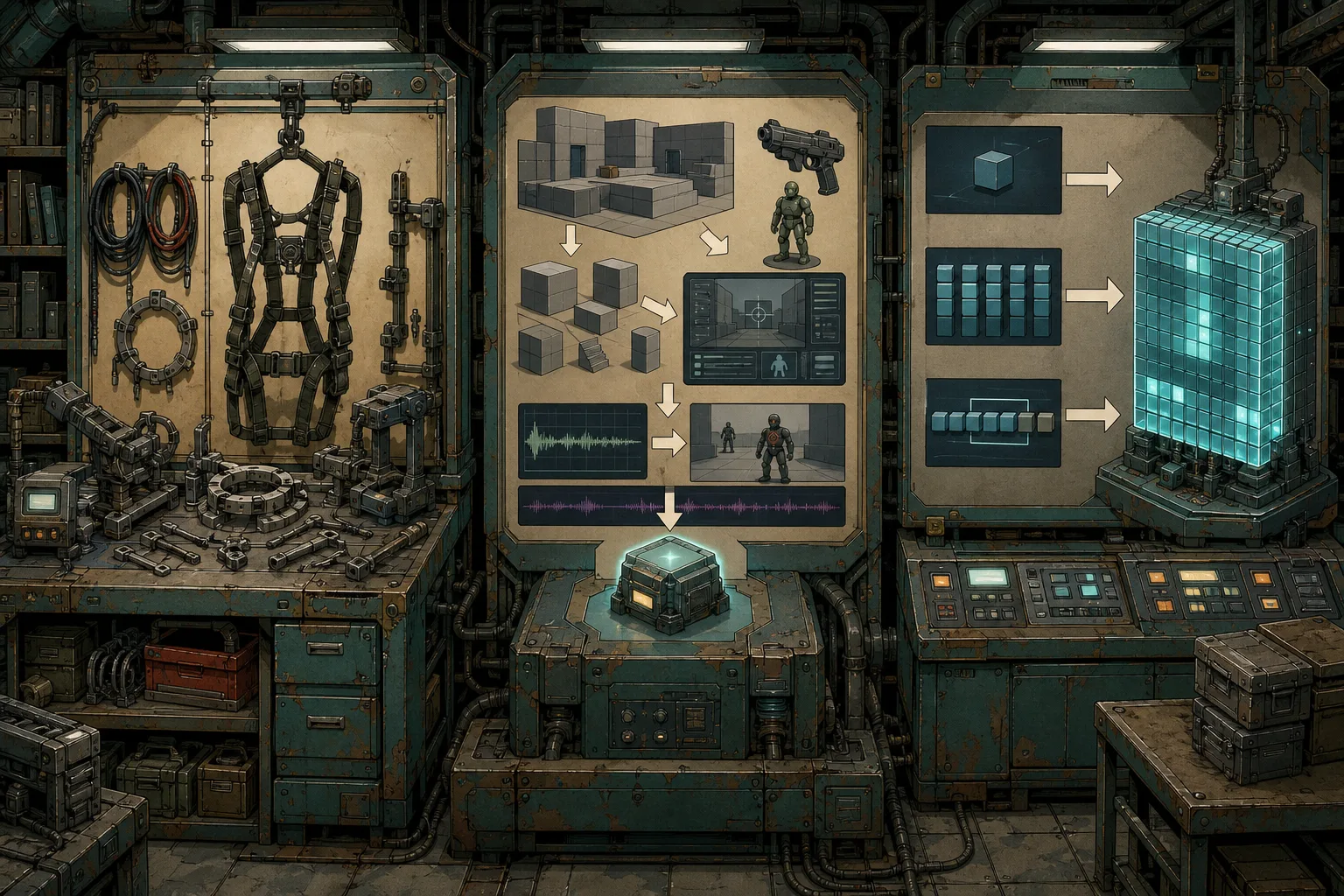
Seven notes: California youth-safety regulation, industrial overcapacity as science catalyst, robotics hardware takeoff, in-context learning's GPT moment, AI as wet-lab co-pilot, a productivity-miracle claim, and Gemini 3.8 Flash / Flash Cyber.
OpenAI's largest training run ships with critical-rated cyber capability, looped computation that weakens chain-of-thought monitoring, and task-based pricing pressure.
Seven notes: Qwen Max 0902's 2.4T post-train, Quasar 438B tops Europe, H3-World turns H3 into a world model with 0.2% params, Fable 5.1 decodes a 373-year cipher, Humain M3 in Arabic, a cancer-vaccine primer, plus Dyson's $499 camera-toothbrush — noted with editorial.
25% cheaper cache reads, 60% fewer cyber false positives, and early lab-validated science from a model that ships as two permissions, not two capabilities.
Five notes: JIT-Agent synthesizes harnesses on the fly, Michigan Robotics open-sources its curriculum, DualView publishes exact phase-specialized weights, plus an ESP32 dashboard and the long-lived free-APIs directory.
Multimodal MoE with GDN+QSA attention, gated residual, n-gram embedding, and Muon — an open-weight preview of the Qwen4 line.
First natively multimodal in the GLM-5 line. 45 layers, hybrid linear-sparse attention with IndexPool, and Manifold-Constrained Hyper-Connections — MIT weights that stay local-feasible.
Four notes from the feed: an experimental vision model, a free agentic model window, CUDA on RISC-V, and a Linux utility for Logitech hardware.
Five more notes: hardware-aware kernels, a tighter matrix multiplication bound, AMD credits, and two SemiAnalysis signals on the CUDA moat.
Meta's Hatch and Watermelon, Perplexity's local-first Portable Computer, Figure's Index dataset, Amazon's automated last mile, Jetson Orin Nano 2, and Keenable's knowledge index.

27 billion dense, native vision-language, 262K to 1M context. Hybrid linear attention in a deployable package.
Meta distilled Spark for the workshop — a 30B model that runs locally and keeps the job on the bench.